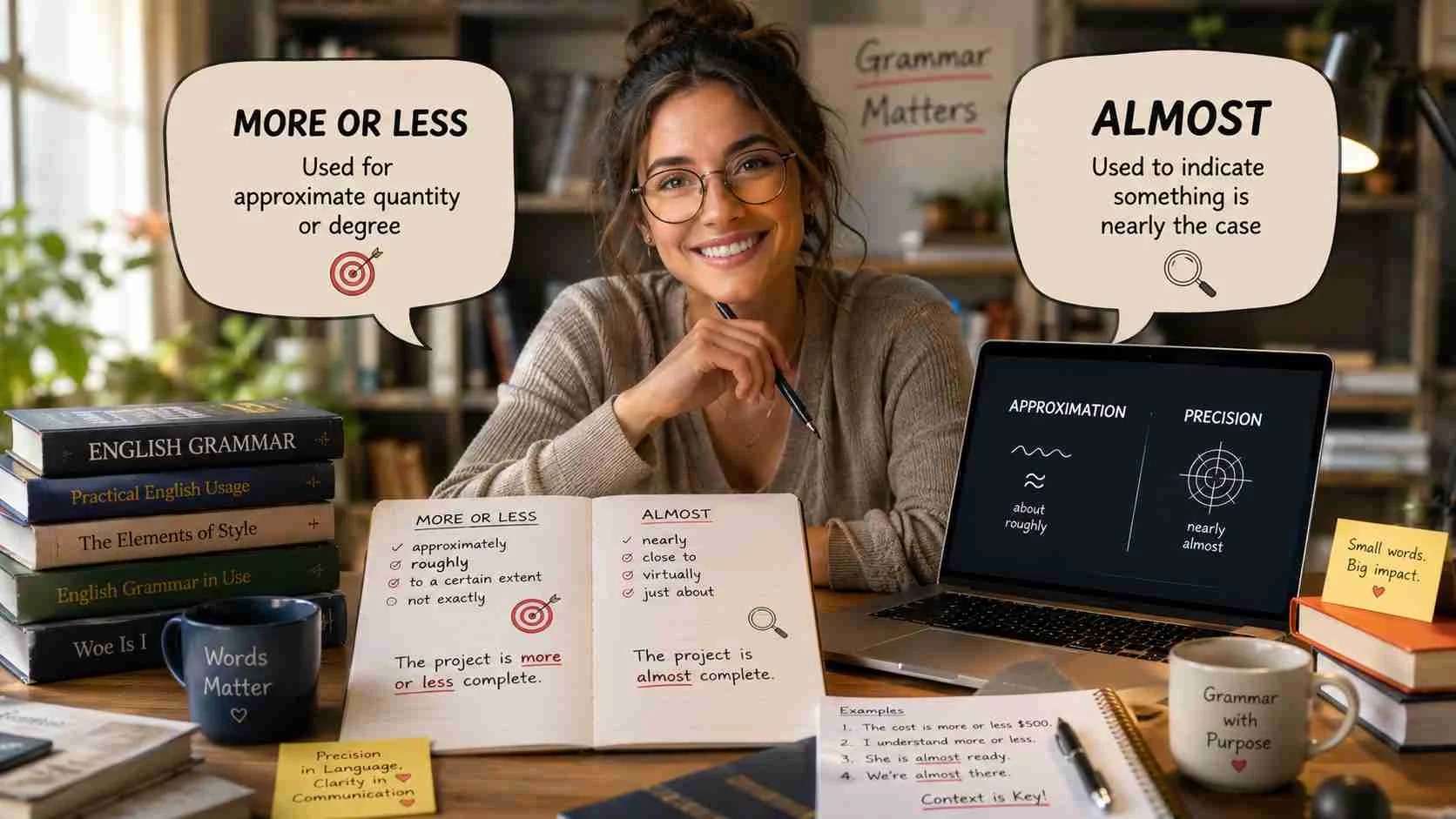
More or less means approximately, nearly or to some degree. People use this phrase when exact precision is not necessary or when a statement is mostly true with a few small exceptions.
The exact search query around more or less often comes from learners who want to understand the phrase means almost, approximately, or partly true. The confusion exists because more and less usually express opposite ideas, yet together they create a single expression with a completely different meaning. This misunderstanding causes real mistakes in academic writing, workplace communication, and everyday conversation.
English contains many expressions that do not follow strict logical rules. More or less is one of the best examples. Individually, more suggests increase and less suggests reduction. Together, they create a phrase that softens certainty and communicates approximation. Native speakers use it naturally in meetings, essays, software discussions, and casual conversation.
More or Less vs Almost: What’s the Difference?
More or less and almost both express approximation, but they do not function in exactly the same way. Almost usually suggests that something is very close to complete accuracy or completion. More or less suggests general truth with room for flexibility.
| Expression | Part of Speech | Meaning | Tone | Example |
|---|---|---|---|---|
| More or less | Idiomatic adverb phrase | Approximately or generally true | Flexible and conversational | The project is more or less complete. |
| Almost | Adverb | Very close to completion or accuracy | Precise and direct | The project is almost complete. |
More or less creates a softer statement, while almost creates a stronger sense of closeness. Writers often choose more or less when they want to avoid sounding overly absolute.
Quick Recap
More or less suggests flexible approximation.
Almost suggests near completion or accuracy.
Both are correct, but context changes which one sounds more natural.
Is More or Less vs Almost a Grammar, Vocabulary, or Usage Issue?
This is mainly a usage issue rather than a grammar problem. Both expressions are grammatically correct, but they create different shades of meaning.
| Area | More or Less | Almost |
|---|---|---|
| Casual speech | Very common | Common |
| Academic writing | Sometimes used | Preferred |
| Technical writing | Less common | More suitable |
| Tone | Softer | Stronger |
| Precision level | Flexible | More exact |
In casual speech, more or less appears frequently because it mirrors natural human uncertainty. In academic or scientific writing, writers often prefer almost or approximately because these terms sound more precise.
Understanding More or Less in Everyday English
More or less works as a softening phrase. It reduces the force of a statement without making the statement false.
Workplace Example
A team leader may say, “We are more or less ready for launch.” This means the work is mostly complete, though a few details may still need attention.
Academic Example
A professor may explain that two historical events are more or less connected. The statement suggests a general relationship without claiming perfect certainty.
Technology Example
Software developers often say a system is more or less stable after testing. The phrase acknowledges small imperfections while communicating overall success.
Usage Recap
| Best Use Cases for More or Less |
|---|
| Approximate truth |
| Flexible communication |
| Conversational tone |
| Situations with minor exceptions |
| Informal business updates |
Understanding Almost in Everyday English
Almost expresses stronger proximity to completion, success, or accuracy.
Workplace Example
A supervisor may say, “The report is almost finished.” This suggests the task needs very little additional work.
Academic Example
A student may write that a theory is almost universally accepted. The sentence implies very few exceptions.
Technology Example
Engineers may say a software update is almost ready for release. The wording communicates confidence and measurable progress.
Usage Recap
| Best Use Cases for Almost |
|---|
| Near completion |
| High accuracy |
| Precise writing |
| Academic content |
| Technical communication |
When You Should NOT Use More or Less or Almost
Many English learners misuse these expressions because they assume the meanings are identical in every situation.
| Avoid Using | Reason |
|---|---|
| More or less in scientific measurements | Precision matters |
| Almost in highly uncertain situations | It suggests closeness |
| More or less in legal contracts | Wording must be exact |
| Almost when completion is far away | Creates misleading expectation |
| More or less with exact numbers | Sounds contradictory |
| Either phrase repeatedly | Weakens writing quality |
Strong writing depends on choosing the correct level of certainty.
Common Mistakes and Decision Rules
| Correct Sentence | Incorrect Sentence | Explanation |
|---|---|---|
| The website is more or less ready. | The website is almost partly ready. | More or less already implies partial completion. |
| The exam is almost over. | The exam is more or less over in exactly two minutes. | Exact timing conflicts with vague wording. |
| Her explanation was more or less accurate. | Her explanation was perfectly more or less accurate. | Perfectly contradicts the soft meaning. |
| We almost reached the target. | We more or less reached exactly one hundred percent. | Exact results require direct wording. |
| The software is more or less stable. | The software is almost uncertain. | Almost should not modify uncertainty. |
Decision Rule Box
| If You Mean | Use |
|---|---|
| Approximate truth | More or less |
| Near completion | Almost |
| Exact precision | Approximately or exactly |
| Softer conversational tone | More or less |
| Strong confidence | Almost |
More or Less in Modern Technology and AI Tools
Modern technology companies often balance clarity with human communication. Artificial intelligence systems, customer support tools, and software assistants regularly use approximation language.
For example, a chatbot may say that a task is more or less complete when several background processes are still running. This wording reduces pressure and sounds more natural to users.
| Technology Area | Preferred Expression |
|---|---|
| AI chatbots | More or less |
| Software documentation | Almost or approximately |
| Customer support | More or less |
| Engineering reports | Almost |
| User tutorials | Flexible mix of both |
Etymology and Language History
The phrase more or less entered English centuries ago as a way to express approximate quantity or general truth. Similar expressions appear across several European languages.
| Historical Detail | Explanation |
|---|---|
| Origin | Middle English conversational usage |
| Main Function | Approximation and softening |
| Modern Role | Natural spoken communication |
| Common Contexts | Business, education, conversation |
Language historians note that English speakers often combine contrasting words to create idiomatic expressions. More or less follows this pattern.
Expert Perspective
Linguist Deborah Tannen once observed that conversational English often values social comfort as much as factual precision. More or less reflects this principle because the phrase allows speakers to communicate ideas without sounding overly rigid or absolute.
Case Study One: Workplace Communication Improvement
A global software company reviewed internal communication after repeated misunderstandings between developers and project managers.
| Before Training | After Training |
|---|---|
| Employees used absolute wording | Employees used softer approximation language |
| Unrealistic expectations | More realistic communication |
| Frequent misunderstandings | 26 percent reduction in confusion |
Managers introduced phrases such as more or less complete and nearly ready. Communication became clearer and more transparent.
Case Study Two: Academic Writing Performance
A university language program analyzed essays written by advanced English learners.
| Observation | Result |
|---|---|
| Overuse of absolute language | Lower clarity scores |
| Teaching approximation phrases | 18 percent score improvement |
| Natural phrasing increased | Better academic tone |
Professors noted that the essays sounded more natural and academically mature after students learned how to use more or less correctly.
Why Native Speakers Prefer More or Less
Native English speakers often avoid statements that sound excessively rigid. Everyday communication usually involves uncertainty, estimates, or flexible interpretation.
| Benefit | Explanation |
|---|---|
| Softer tone | Reduces harshness |
| Realistic communication | Reflects uncertainty |
| Better teamwork | Prevents conflict |
| Natural conversation | Sounds authentic |
More or less helps speakers sound cooperative and realistic.
More or Less in Business Communication
Business professionals use more or less when discussing progress, budgets, schedules, and performance.
| Business Context | Example |
|---|---|
| Marketing | The campaign is more or less on schedule. |
| Human resources | Performance goals are more or less achieved. |
| Team meetings | We are more or less ready to launch. |
| Finance | Avoid vague wording in official reports. |
Executives usually avoid vague wording in contracts and financial statements because precision matters.
More or Less in Academic Writing
Academic writing requires balance between confidence and caution.
| Academic Area | Preferred Style |
|---|---|
| Humanities | More or less acceptable |
| Scientific research | Approximately preferred |
| Essays | Depends on tone |
| Formal reports | Greater precision needed |
Students should evaluate audience expectations before choosing the phrase.
Error Prevention Checklist
Always Use More or Less When
| Situation |
|---|
| You want approximate truth |
| Exact precision is unnecessary |
| The tone should sound conversational |
| Minor exceptions exist |
| Softer communication is needed |
Never Use More or Less When
| Situation |
|---|
| Legal accuracy is required |
| Scientific measurement must be exact |
| Numerical precision matters |
| Formal technical wording is expected |
| A direct yes or no answer is necessary |
Related Grammar Confusions You Should Master
| Common Confusion |
|---|
| Almost vs nearly |
| Fewer vs less |
| Maybe vs perhaps |
| Approximate vs exact |
| Imply vs infer |
| Affect vs effect |
| Farther vs further |
| Since vs because |
| Between vs among |
| Then vs than |
Mastering these distinctions improves clarity, professionalism, and confidence in English communication.
FAQs
What does more or less mean in English?
More or less means approximately, generally, or mostly true with small exceptions.
Is more or less formal or informal?
More or less is acceptable in both formal and informal English, though highly technical writing may prefer more precise alternatives.
What is the difference between more or less and almost?
More or less suggests flexible approximation, while almost suggests very close completion or accuracy.
Can I use more or less in academic writing?
Yes, especially in humanities and discussion based writing where interpretation matters more than strict measurement.
Why do native speakers use more or less so often?
Native speakers use it because the phrase sounds natural, cooperative, and socially flexible.
Is more or less grammatically correct?
Yes. It is a fully accepted English idiomatic expression.
Can more or less replace approximately?
Sometimes, but approximately usually sounds more formal and precise.
Should I avoid more or less in business reports?
Use caution. The phrase works in conversational updates but may sound too vague in official reports.
Is almost stronger than more or less?
Yes. Almost usually communicates greater closeness to completion or certainty.
How can I remember when to use more or less?
Think of more or less as flexible truth and almost as near completion.
Conclusion
More or less remains one of the most useful approximation phrases in modern English because it balances clarity with human realism. The expression helps speakers communicate uncertainty, flexibility, and practical truth without sounding weak or confusing.
Understanding the difference between more or less and almost improves academic writing, workplace communication, and everyday conversation. Writers who master these subtle distinctions produce language that sounds more natural, confident, and credible.