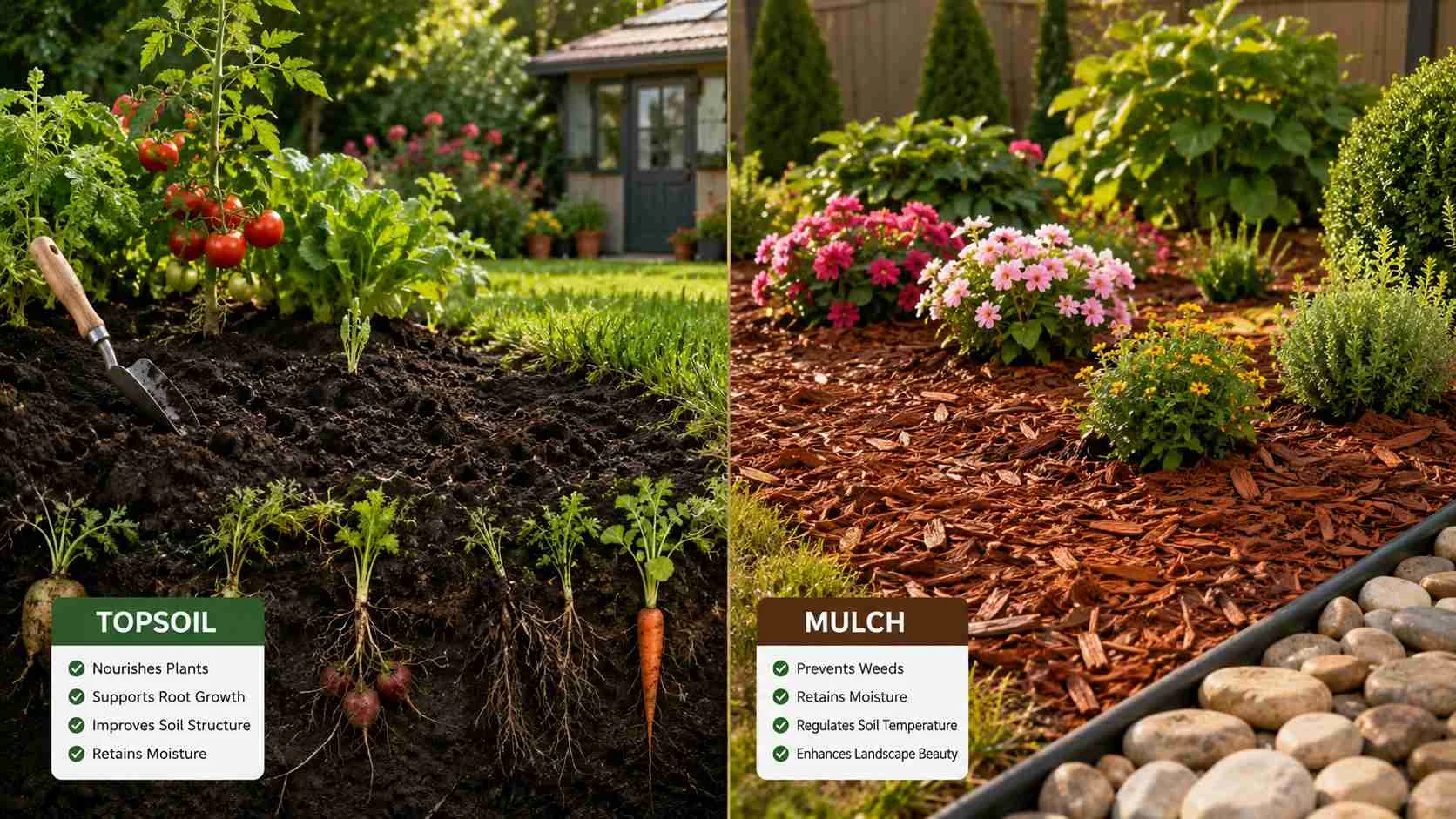
Topsoil or mulch refers to two very different landscaping materials that people often confuse. Topsoil is nutrient rich soil used for planting and improving ground quality, while mulch is a protective layer placed on top of soil to retain moisture, reduce weeds, and regulate temperature.
The phrase “topsoil or mulch” confuses many homeowners, gardeners, landscapers, and even beginners working on outdoor projects for the first time. Although both materials are used in gardens and landscaping, they serve completely different purposes. Topsoil is a growing medium packed with organic matter and minerals, while mulch acts as a protective covering spread over soil surfaces.
This confusion causes real mistakes. Many people buy mulch expecting plants to grow directly in it, while others use topsoil where weed control or moisture retention is needed. The result can include unhealthy plants, compacted soil, drainage problems, or unnecessary spending. Understanding the difference helps you choose the right material for lawns, flower beds, vegetable gardens, and landscaping projects.
Topsoil vs Mulch: What’s the Difference?
They differ in composition, placement, purpose, and long term effects. Topsoil becomes part of the ground itself, while mulch stays on the surface as a protective barrier.
| Feature | Topsoil | Mulch |
|---|---|---|
| Primary Purpose | Improve soil quality and support plant growth | Protect soil and conserve moisture |
| Placement | Mixed into or spread as soil | Placed on top of soil |
| Composition | Sand, clay, silt, organic matter | Wood chips, bark, straw, leaves, compost |
| Nutrient Content | High nutrient potential | Usually low to moderate nutrients |
| Water Retention | Helps roots absorb moisture | Prevents evaporation |
| Weed Control | Limited | Excellent |
| Best For | Planting, leveling, gardening | Landscaping, weed prevention |
| Lifespan | Permanent soil layer | Breaks down over time |
Topsoil forms the foundation of healthy planting areas. It contains essential minerals and microorganisms that support root development. Mulch, on the other hand, protects that foundation from heat, erosion, and moisture loss.
In simple terms, topsoil feeds plants from below, while mulch protects plants from above. Most successful gardens actually use both materials together rather than choosing only one.
Is Topsoil or Mulch a Grammar, Vocabulary or Usage Issue?
The phrase “topsoil or mulch” is mainly a vocabulary and usage issue rather than a grammar problem. People confuse the words because both belong to the same landscaping category and are often sold side by side in garden centers.
Are They Interchangeable?
No. These terms are not interchangeable because they describe different materials with different functions. Using one in place of the other changes how plants grow and how soil behaves.
Formal vs Informal Usage
In professional landscaping, horticulture, and agriculture, the distinction is very important. Contractors, gardeners, and landscape architects use the terms precisely because incorrect usage can affect project results.
In casual conversation, however, people often use “dirt,” “soil,” “mulch,” and “compost” loosely, which creates confusion.
Academic vs Casual Usage
In academic and agricultural settings:
- Topsoil refers specifically to the uppermost fertile soil layer.
- Mulch refers to surface covering materials designed for protection.
In casual home improvement discussions, people sometimes refer to any brown landscaping material as “soil” or “mulch,” even when the product is entirely different.
| Context | Correct Usage |
|---|---|
| Gardening class | Use precise definitions |
| Landscaping contract | Must distinguish clearly |
| Casual conversation | Often mixed incorrectly |
| Agricultural research | Highly technical distinction |
| DIY home projects | Frequently confused |
The confusion is understandable because both materials are often purchased together. Still, knowing the distinction prevents expensive landscaping mistakes.
What Is Topsoil?
Topsoil is the uppermost layer of soil where most biological activity occurs. It contains organic matter, nutrients, microorganisms, and minerals necessary for healthy plant growth.
Gardeners use topsoil to improve planting beds, fill uneven areas, establish lawns, and support root systems.
Types of Topsoil
| Type | Best Use |
|---|---|
| Screened topsoil | Lawns and leveling |
| Enriched topsoil | Flower beds and gardens |
| Sandy topsoil | Drainage improvement |
| Clay based topsoil | Moisture retention |
| Organic topsoil | Vegetable gardening |
Workplace Example
A landscaping contractor preparing a commercial office lawn uses screened topsoil to create a smooth planting surface before laying grass seed.
Academic Example
Agricultural researchers analyze topsoil composition to study nutrient levels and crop productivity.
Technology Example
Modern smart farming systems use soil sensors inserted into topsoil to monitor moisture, pH balance, and nutrient health in real time.
Topsoil Usage Recap
Topsoil is best when you need to grow, support, or improve plant life. It works beneath the surface and directly influences root development and nutrient absorption.
What Is Mulch?
Mulch is a material spread over the surface of soil to protect it from heat, erosion, evaporation, and weed growth. It may be organic or inorganic depending on the application.
Organic mulch gradually decomposes and improves soil quality over time, while inorganic mulch focuses mainly on protection and appearance.
Common Types of Mulch
| Mulch Type | Main Benefit |
|---|---|
| Bark mulch | Decorative landscaping |
| Wood chips | Weed suppression |
| Straw mulch | Vegetable gardens |
| Compost mulch | Nutrient improvement |
| Rubber mulch | Long lasting coverage |
| Pine needles | Acid loving plants |
Workplace Example
A property maintenance company spreads mulch around office landscaping to reduce weeds and lower maintenance costs.
Academic Example
Environmental science students study how mulch affects soil temperature and water retention in agricultural experiments.
Technology Example
Landscape designers use digital garden planning software to calculate mulch depth and coverage areas for large scale projects.
Mulch Usage Recap
Mulch protects and preserves soil conditions. It is not primarily intended for direct planting or root support.
Topsoil vs Mulch: Side by Side Functional Comparison
| Function | Topsoil | Mulch |
|---|---|---|
| Supports root growth | Yes | No |
| Retains soil moisture | Moderate | Excellent |
| Prevents weeds | Limited | Strong |
| Adds nutrients | Yes | Sometimes |
| Improves drainage | Yes | No |
| Protects against erosion | Moderate | Strong |
| Decorative appeal | Minimal | High |
| Used for planting | Yes | Rarely |
This comparison highlights why professional gardeners often combine both. Topsoil builds healthy growing conditions, while mulch protects those conditions.
When You Should Use Topsoil
Topsoil is ideal when the goal involves plant establishment, soil improvement, or land preparation.
Creating New Lawns
Fresh topsoil helps grass seed germinate evenly and creates stronger root systems.
Building Garden Beds
Vegetable gardens and flower beds require nutrient rich topsoil to support growth.
Leveling Uneven Areas
Landscapers use topsoil to fill low spots and create smooth surfaces.
Repairing Damaged Soil
Construction projects often leave compacted or nutrient poor soil. Adding quality topsoil restores fertility.
Supporting Raised Beds
Raised garden beds depend heavily on high quality topsoil blends.
Improving Drainage
Specific topsoil mixes can improve water movement in problem areas.
When You Should Use Mulch
Mulch becomes valuable when protection, moisture retention, and maintenance reduction are priorities.
Weed Prevention
A thick mulch layer blocks sunlight and slows weed growth significantly.
Moisture Conservation
Mulch reduces evaporation during hot weather.
Soil Temperature Regulation
Roots stay cooler in summer and warmer in winter under mulch coverage.
Decorative Landscaping
Colored mulch enhances curb appeal and creates visual contrast.
Erosion Control
Mulch protects exposed soil from wind and heavy rain.
Reduced Maintenance
Garden beds with mulch require less watering and fewer weed removal sessions.
When You Should NOT Use Topsoil or Mulch
Many landscaping failures happen because these materials are used incorrectly.
| Situation | Avoid Topsoil | Avoid Mulch |
|---|---|---|
| Around tree trunks | No | Thick mulch volcanoes |
| Direct seed germination with heavy cover | No | Yes |
| Indoor potted plants only | Sometimes | Usually |
| Poor drainage areas without amendment | Yes | No |
| Planting directly into wood mulch | No | Yes |
| Heavy compacted layers | Yes | No |
| Over septic systems | Sometimes | Sometimes |
| Excessively wet climates | No | Thick mulch use |
Common Misuse Scenarios
- Planting directly into decorative mulch instead of soil
- Using cheap topsoil full of debris and clay
- Applying mulch too thickly around tree trunks
- Assuming mulch replaces fertilizer
- Spreading topsoil over weeds without preparation
- Using dyed mulch in vegetable gardens carelessly
- Ignoring drainage needs when choosing topsoil
- Applying mulch against house siding, causing moisture issues
Understanding these mistakes helps homeowners avoid plant stress, fungal growth, and wasted landscaping budgets.
Common Mistakes and Decision Rules
| Correct Sentence | Incorrect Sentence | Explanation |
|---|---|---|
| Add topsoil before planting grass seed | Add mulch before planting grass seed | Grass roots need soil, not surface covering |
| Spread mulch around flower beds | Spread topsoil around flower beds for weed control | Mulch controls weeds better |
| Mix topsoil into raised beds | Fill raised beds entirely with mulch | Plants require nutrient rich growing media |
| Apply mulch after watering | Apply topsoil on top of established mulch | Soil should remain beneath mulch |
| Use mulch to reduce evaporation | Use topsoil to stop weeds completely | Soil alone will not block weeds effectively |
Decision Rule Box
If you mean improving the planting surface and root environment, use topsoil.
If you mean protecting soil and reducing weeds, use mulch.
And if you want healthier gardens overall, combine both strategically.
Can You Use Topsoil and Mulch Together?
Yes, and in most professional landscaping projects, you should.
A common method involves first preparing the planting area with quality topsoil. After planting is complete, mulch is added on top to preserve moisture and reduce weeds.
Proper Layering Process
| Step | Action |
|---|---|
| Step 1 | Prepare ground |
| Step 2 | Add or amend topsoil |
| Step 3 | Plant seeds or plants |
| Step 4 | Water thoroughly |
| Step 5 | Apply mulch layer |
| Step 6 | Leave space around stems |
This layered approach creates healthier plants and lowers maintenance costs over time.
Topsoil or Mulch for Vegetable Gardens?
Vegetable gardens require both, but timing matters.
Topsoil forms the growing base where vegetables develop roots and absorb nutrients. Mulch is added afterward to conserve moisture and prevent weeds.
Organic mulches such as straw or compost work especially well for vegetable gardens because they break down naturally and improve soil quality.
Best Combination for Vegetable Gardens
| Garden Need | Recommended Material |
|---|---|
| Root growth | Topsoil |
| Weed suppression | Mulch |
| Water retention | Mulch |
| Nutrient support | Topsoil |
| Temperature control | Mulch |
Gardeners who skip mulch often spend much more time watering and weeding during summer.
Topsoil or Mulch for Landscaping?
For decorative landscaping, mulch often receives more attention because it creates visible curb appeal. However, topsoil still matters beneath shrubs, flowers, and trees.
A healthy landscape depends on strong soil structure underneath decorative materials.
Best Landscaping Strategy
- Improve poor soil with topsoil
- Install plants correctly
- Apply mulch evenly
- Refresh mulch annually
- Test soil every few years
Professional landscapers rarely rely on mulch alone because attractive gardens still require healthy root systems.
Topsoil or Mulch for Grass?
Grass establishment depends primarily on topsoil.
Fresh topsoil provides the loose, nutrient rich environment needed for seed germination. Mulch may occasionally help protect newly seeded areas, but it should never replace soil.
Lawn Establishment Comparison
| Lawn Goal | Topsoil | Mulch |
|---|---|---|
| Seed germination | Excellent | Poor |
| Root development | Excellent | Poor |
| Moisture retention | Moderate | Moderate |
| Weed suppression | Limited | Moderate |
| Surface leveling | Excellent | None |
Homeowners sometimes spread mulch directly over grass seed too heavily, preventing sunlight and airflow. This often leads to patchy lawns.
Cost Comparison: Topsoil vs Mulch
| Material | Average Cost Range | Longevity |
|---|---|---|
| Basic topsoil | Moderate | Long term |
| Premium topsoil | Higher | Long term |
| Bark mulch | Moderate | Seasonal |
| Rubber mulch | Higher | Multi year |
| Straw mulch | Low | Short term |
Mulch usually requires replenishment because it decomposes or fades over time. Topsoil, however, becomes part of the permanent landscape structure.
Environmental Impact of Topsoil and Mulch
Topsoil conservation is a major environmental issue worldwide. Healthy topsoil supports food production, biodiversity, and water filtration.
Mulch also provides environmental benefits by reducing water evaporation and minimizing herbicide use.
Eco Friendly Benefits
| Environmental Benefit | Topsoil | Mulch |
|---|---|---|
| Supports biodiversity | Yes | Moderate |
| Conserves water | Moderate | Strong |
| Reduces erosion | Moderate | Strong |
| Improves soil health | Strong | Moderate |
| Reduces chemical use | Moderate | Strong |
Using organic mulch and responsibly sourced topsoil creates more sustainable landscapes.
Topsoil and Mulch in Modern Technology and AI Tools
Modern landscaping increasingly relies on artificial intelligence, mapping systems, and smart sensors.
AI powered gardening apps can now recommend the correct topsoil blend based on climate, drainage, and plant type. Landscape design platforms estimate mulch coverage automatically, reducing waste and improving budgeting accuracy.
Smart irrigation systems also monitor moisture levels beneath mulch layers to optimize watering schedules. This technology helps homeowners save water while maintaining healthier plants.
The Etymology of Topsoil and Mulch
The word “topsoil” combines “top” and “soil,” referring to the upper fertile layer of earth.
The word “mulch” comes from the German word “molsch,” meaning soft or decayed material. Historically, farmers used straw, leaves, and organic debris as protective ground coverings centuries before modern landscaping existed.
Understanding the origins of these terms reinforces their distinct functions.
Expert Insight
“Healthy landscapes are built from the ground up. Topsoil creates life below the surface, while mulch protects that life above it.”
This principle guides professional horticulturists, landscape architects, and agricultural experts worldwide.
Case Study 1: Residential Garden Transformation
A homeowner in Arizona struggled with dry, compacted soil and constant weed growth. Initially, decorative mulch was added without improving the underlying soil.
Results were disappointing:
- Plants wilted quickly
- Water evaporated rapidly
- Weed growth continued
After replacing the upper layer with enriched topsoil and adding organic mulch afterward, the garden improved dramatically within one growing season.
Results
| Improvement | Outcome |
|---|---|
| Water usage | Reduced by 35 percent |
| Plant survival | Increased significantly |
| Weed growth | Reduced dramatically |
| Soil moisture | Retained longer |
Case Study 2: Commercial Landscaping Project
A commercial office complex installed low quality fill dirt beneath decorative mulch. Within months, shrubs began failing because roots could not establish properly.
Landscape consultants replaced the fill material with screened topsoil and reapplied mulch correctly.
Results
| Metric | Before | After |
|---|---|---|
| Shrub survival | 58 percent | 94 percent |
| Maintenance costs | High | Lower |
| Irrigation frequency | Frequent | Reduced |
| Visual quality | Inconsistent | Professional |
These real world examples demonstrate why understanding topsoil and mulch matters beyond simple terminology.
Author Expertise
This article was prepared by a senior SEO content strategist and language specialist with more than a decade of experience creating high authority educational content in landscaping, home improvement, and semantic search optimization.
Error Prevention Checklist
Always Use Topsoil When
- Planting grass seed
- Building garden beds
- Improving poor soil
- Supporting root development
- Filling uneven ground
- Growing vegetables
Never Use Mulch When
- You need direct root support
- Planting seeds deeply
- Replacing actual soil
- Filling raised beds entirely
- Covering tree trunks excessively
- Creating drainage structure
Related Landscaping and Gardening Confusions You Should Master
Understanding similar terminology mistakes improves landscaping knowledge overall.
| Confusing Terms | Key Difference |
|---|---|
| Compost vs fertilizer | Organic matter versus nutrient additives |
| Soil vs dirt | Living medium versus displaced earth |
| Mulch vs compost | Protection versus decomposition |
| Sand vs gravel | Texture and drainage differences |
| Potting soil vs garden soil | Container use versus ground use |
| Clay vs loam | Soil density and fertility |
| Annuals vs perennials | Plant lifespan differences |
| Topsoil vs fill dirt | Fertility versus structural use |
| Organic mulch vs inorganic mulch | Biodegradable versus permanent |
| Lawn soil vs garden soil | Specialized nutrient balance |
Mastering these distinctions helps homeowners make smarter gardening decisions.
FAQs
What is the main difference between topsoil and mulch?
The main difference is that topsoil supports plant growth beneath the surface, while mulch protects the soil surface above it. Topsoil contains nutrients and organic matter for roots, whereas mulch mainly helps retain moisture and suppress weeds.
Can plants grow directly in mulch?
Most plants should not grow directly in mulch because mulch does not provide the stable root environment plants need. Seeds and roots generally require actual soil or topsoil for proper development.
Should I use topsoil or mulch for grass seed?
Topsoil is the correct choice for grass seed because it supports germination and root growth. Mulch may lightly protect newly seeded areas, but it should never replace soil.
Is mulch better than topsoil for weed control?
Yes. Mulch is much more effective for weed suppression because it blocks sunlight from reaching weed seeds. Topsoil alone cannot prevent weed growth effectively.
Can I put mulch over topsoil?
Yes, and this is considered best practice in gardening and landscaping. Topsoil improves the planting environment, and mulch protects that improved soil afterward.
Which is cheaper: topsoil or mulch?
Costs vary depending on quality and type, but basic mulch and basic topsoil are often similarly priced. However, mulch usually requires more frequent replacement.
Do vegetable gardens need topsoil or mulch?
Vegetable gardens benefit from both. Topsoil supports nutrient absorption and root growth, while mulch conserves moisture and reduces weed competition.
Can too much mulch harm plants?
Yes. Excessive mulch can trap moisture, encourage rot, and reduce airflow around stems and trunks. Thick “mulch volcanoes” around trees are especially harmful.
What type of mulch is best for gardens?
Organic mulches such as straw, bark, shredded leaves, and compost are usually best because they gradually improve soil quality while protecting the surface.
Does mulch eventually turn into topsoil?
Organic mulch slowly decomposes and contributes organic matter to soil over time, but it does not instantly become high quality topsoil. The transformation happens gradually through decomposition.
Conclusion
Understanding topsoil or mulch is essential for successful gardening and landscaping. Although the two materials often appear together in stores and outdoor projects, they perform entirely different functions. Topsoil creates the nutrient rich foundation plants need for healthy growth, while mulch protects that foundation from weeds, heat, and moisture loss.
Choosing correctly saves money, improves plant health, and reduces long term maintenance. In most cases, the best strategy is not choosing one over the other but using both together in the right order. Healthy landscapes begin with strong soil and stay protected with quality mulch.
Discover More Related Articles:
- Wax or Dermaplane | Which Hair Removal Method Is Better for Smooth Skin In 2026
- Balustrade or Bannister | Which One Is the Correct Architectural Term In 2026
- Donuts or Medford | Where to Find the Best Sweet Treats in Town In 2026