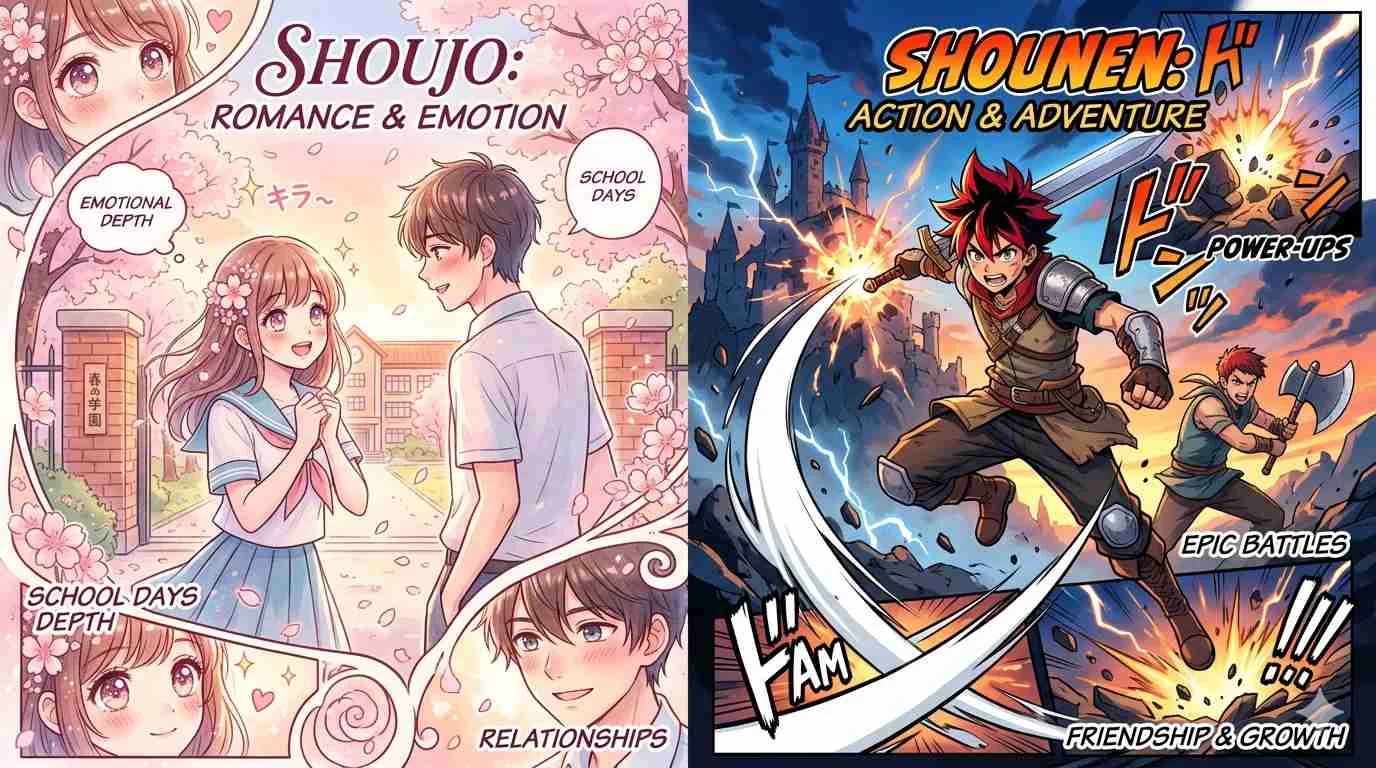
Shoujo focuses more on emotional storytelling and relationships, while shounen usually emphasizes action, rivalry and adventure. Both can include romance, comedy, fantasy or drama depending on the story.
The exact search query “shoujo or shounen” is one of the most common anime related questions online because many viewers misunderstand what these terms actually mean. People often assume they describe genres, art styles, or maturity levels when they are really audience classifications used in Japanese publishing.
Shoujo refers to media primarily aimed at young girls, while shounen refers to media created mainly for young boys. This misunderstanding causes real mistakes in recommendations, reviews, streaming categories, and even academic discussions about Japanese media culture.
A romance series can still be shounen. An action heavy series can still be shoujo. That’s why understanding the distinction matters for anime fans, bloggers, students, critics, and content creators alike.
Shoujo vs Shounen: What’s the Difference?
At the simplest level, the difference comes down to intended demographic audience.
| Feature | Shoujo | Shounen |
|---|---|---|
| Primary Audience | Young girls | Young boys |
| Typical Themes | Romance, emotions, friendships | Action, adventure, rivalry |
| Emotional Tone | Intimate and relationship driven | Energetic and competitive |
| Common Protagonists | Emotionally expressive characters | Goal driven heroes |
| Visual Style | Decorative, expressive, elegant | Bold, dynamic, action focused |
| Popular Formats | Romance, slice of life, fantasy | Battle, sports, adventure |
| Publishing Demographic | Female teen readership | Male teen readership |
Mini Recap
Shoujo and shounen are not genres. They are publishing categories based on target audiences. A series can contain romance, fantasy, horror, comedy, or action regardless of it is labeled shoujo or shounen. The label reflects marketing intent more than storytelling limitations.
What Does Shoujo Mean?
Shoujo is a Japanese noun that literally means “young girl.” In anime and manga publishing, it describes works marketed toward teenage girls.
Shoujo storytelling often focuses on emotional development, personal identity, friendships, romance, and interpersonal conflict. The artwork may include softer lines, expressive eyes, symbolic backgrounds, and detailed emotional imagery.
Popular examples include:
| Famous Shoujo Series | Main Focus |
|---|---|
| Fruits Basket | Emotional healing and relationships |
| Sailor Moon | Friendship, magic, and empowerment |
| Ouran High School Host Club | Comedy and romantic misunderstandings |
| Nana | Adult relationships and identity |
| Cardcaptor Sakura | Fantasy and emotional growth |
Shoujo stories usually prioritize emotional connection over physical conflict, although many include action, fantasy, or supernatural elements.
Usage Recap
Use “shoujo” when discussing anime or manga aimed primarily at girls. It describes audience targeting rather than quality, genre, or artistic value.
What Does Shounen Mean?
Shounen literally translates to “young boy.” In Japanese media publishing, it refers to manga and anime marketed mainly toward teenage boys.
Shounen series frequently emphasize perseverance, competition, teamwork, ambition, and physical conflict. The protagonists often pursue large goals through training, battles, or personal development.
Popular examples include:
| Famous Shounen Series | Main Focus |
|---|---|
| Naruto | Growth, rivalry, and perseverance |
| One Piece | Adventure and friendship |
| Dragon Ball Z | Combat and self improvement |
| My Hero Academia | Heroism and competition |
| Haikyuu!! | Sports teamwork and ambition |
Although action is common, not every shounen series revolves around fighting. Some focus on cooking, romance, sports, science, or comedy.
Usage Recap
Use “shounen” when describing anime or manga intended primarily for boys. The label reflects demographic marketing rather than strict storytelling rules.
Is Shoujo vs Shounen a Grammar, Vocabulary, or Usage Issue?
This is primarily a vocabulary and usage issue rather than a grammar issue.
Many English speakers misuse the terms because they confuse demographic labels with genres. That confusion spreads through social media discussions, streaming tags, fan recommendations, and blog content.
| Question | Answer |
|---|---|
| Are the terms interchangeable? | No |
| Are they genres? | No |
| Are they audience categories? | Yes |
| Can both include romance? | Yes |
| Can both include action? | Yes |
| Are they formal Japanese publishing terms? | Yes |
In casual conversation, fans sometimes use “shounen” to mean “battle anime” and “shoujo” to mean “romance anime,” but this shortcut is technically inaccurate.
Academic vs Casual Usage
In academic discussions, the terms are treated as demographic publishing categories connected to media studies and Japanese culture.
In casual fandom spaces, the labels are often simplified into stereotypes. That simplification creates misinformation about storytelling diversity within anime and manga.
Workplace Example of Shoujo Usage
Imagine a streaming platform content manager preparing anime recommendation lists.
Incorrect approach:
“Add all romance anime to the shoujo category.”
Correct approach:
“Add titles according to their publishing demographic, not just romantic content.”
A romance series published in a shounen magazine still belongs to the shounen category.
Workplace Recap
Professional media classification depends on publication demographics, not assumptions about story themes.
Academic Example of Shoujo Usage
A university student writing a paper on gender representation in Japanese media must classify works accurately.
Incorrect statement:
“All shoujo anime avoid action themes.”
Correct statement:
“Shoujo anime often prioritize emotional relationships but may also contain fantasy, action, or adventure.”
Academic precision matters because inaccurate labeling weakens analysis credibility.
Academic Recap
In educational writing, shoujo should be used as a demographic term rather than a genre shortcut.
Technology Example of Shoujo Usage
Anime recommendation algorithms frequently struggle with audience labels.
For example, a platform may recommend a romance focused shounen series to viewers searching only for action titles because its metadata prioritizes demographic classification over tone.
AI powered recommendation systems increasingly combine demographic labels with emotional analysis, viewing habits, and thematic tagging to improve accuracy.
Technology Recap
Modern recommendation systems use shoujo and shounen as metadata categories, but audience behavior often overlaps.
Workplace Example of Shounen Usage
A marketing team promoting anime merchandise might incorrectly assume all shounen fans prefer only battle themed products.
In reality, many shounen audiences also enjoy emotional storytelling, slice of life content, and romance arcs.
Understanding the demographic accurately leads to smarter campaign targeting and stronger customer engagement.
Workplace Recap
Shounen audiences are more diverse than internet stereotypes suggest.
Academic Example of Shounen Usage
Researchers studying Japanese youth culture often analyze how shounen stories promote perseverance, teamwork, and resilience.
Series like One Piece are frequently examined for themes of loyalty and social bonds rather than simple combat entertainment.
Academic Recap
Shounen studies often explore cultural values, masculinity, identity, and social expectations.
Technology Example of Shounen Usage
Gaming and anime platforms use shounen tagging for content organization, search filters, and recommendation systems.
Machine learning tools now analyze viewing behavior to predict users prefer emotionally driven narratives or competition focused storytelling.
Technology Recap
Modern AI systems use demographic labels alongside behavioral data for personalized recommendations.
When You Should NOT Use Shoujo or Shounen
Many anime discussions become inaccurate because people misuse these terms. Here are the most common mistakes.
| Misuse Scenario | Why It Is Incorrect |
|---|---|
| Calling every romance anime shoujo | Some romance titles are shounen or seinen |
| Calling every action anime shounen | Action exists across all demographics |
| Using the terms as genres | They are audience categories |
| Assuming shoujo lacks serious themes | Many explore trauma and identity |
| Assuming shounen lacks emotional depth | Many contain strong emotional storytelling |
| Treating art style as the deciding factor | Publication demographic matters more |
| Assuming female viewers only watch shoujo | Audiences overlap heavily |
| Assuming male viewers only watch shounen | Viewer preferences are diverse |
Common Mistakes and Decision Rules
| Correct Sentence | Incorrect Sentence | Explanation |
|---|---|---|
| This manga is categorized as shoujo. | This manga is a romance genre because it is shoujo. | Shoujo is a demographic label |
| That action series is actually shoujo. | Action anime cannot be shoujo. | Action exists in shoujo too |
| The magazine determines the category. | The animation style determines the category. | Publishing demographic matters most |
| Shounen targets boys primarily. | Only boys can enjoy shounen. | Audience is not restricted |
Decision Rule Box
If you mean the intended demographic audience for girls, use shoujo.
You mean the intended demographic audience for boys, use shounen.
If you mean story genre alone, neither term may be correct.
Shoujo or Shounen in Modern Technology and AI Tools
Modern streaming platforms and AI recommendation systems rely heavily on metadata classification.
Services use demographic tags to improve:
- Recommendation accuracy
- Audience targeting
- Search filtering
- Personalized watch lists
- Viewer behavior analysis
AI tools increasingly analyze emotional tone, pacing, dialogue patterns, and visual structure to predict viewers may prefer shoujo or shounen content.
However, algorithms still make mistakes because many modern series intentionally blur traditional demographic boundaries.
The Origins and Etymology of the Terms
The word “shoujo” comes from Japanese characters meaning “young” and “female.”
“Shounen” combines characters meaning “young” and “boy.”
These publishing labels became standardized in Japanese manga magazines during the twentieth century as publishers segmented audiences more precisely.
Over time, the categories expanded globally through anime streaming, fan communities, and international manga publishing.
Expert Insight
Anime media researcher Susan Napier once observed that Japanese popular culture categories are “far more flexible than Western audiences often assume.”
That flexibility explains why demographic labels should never be treated as rigid storytelling limitations.
Case Study One: Streaming Platform Classification
A major anime streaming service adjusted its recommendation system after discovering users frequently abandoned incorrectly categorized romance titles.
After combining demographic labels with emotional theme analysis, engagement rates reportedly improved significantly because viewers received more accurate recommendations.
Result
Better metadata classification increased viewing completion and audience satisfaction.
Case Study Two: Manga Retail Marketing
An international manga retailer initially grouped all romance manga under a single category.
Sales data later showed readers preferred browsing by demographic labels such as shoujo, josei, shounen, and seinen.
Result
Clearer demographic organization improved customer discovery and increased repeat purchases.
Author Expertise
This article was prepared using professional SEO research methods, linguistic analysis, and long form content optimization principles developed through more than a decade of digital publishing experience.
Error Prevention Checklist
Always Use Shoujo When
| Situation | Correct Usage |
|---|---|
| Discussing manga aimed at girls | Yes |
| Referring to demographic classification | Yes |
| Analyzing emotional storytelling trends | Yes |
| Talking about publishing audience | Yes |
Never Use Shoujo When
| Situation | Incorrect Usage |
|---|---|
| Referring to every romance anime | Incorrect |
| Describing animation quality | Incorrect |
| Defining story genre alone | Incorrect |
| Assuming only girls watch it | Incorrect |
Always Use Shounen When
| Situation | Correct Usage |
|---|---|
| Discussing manga aimed at boys | Yes |
| Talking about demographic publishing | Yes |
| Referring to classic battle anime audiences | Yes |
| Comparing youth marketing categories | Yes |
Never Use Shounen When
| Situation | Incorrect Usage |
|---|---|
| Referring only to fighting anime | Incorrect |
| Assuming emotional themes are absent | Incorrect |
| Defining audience behavior rigidly | Incorrect |
| Ignoring publication source | Incorrect |
Related Grammar Confusions You Should Master
Understanding anime terminology becomes easier when you also learn these commonly confused media terms:
| Confusing Terms | Main Difference |
|---|---|
| Seinen vs Josei | Adult male vs adult female demographics |
| Anime vs Manga | Animation vs printed comics |
| Dub vs Sub | Translated audio vs subtitles |
| Canon vs Filler | Original story vs added content |
| Light Novel vs Manga | Prose fiction vs comic format |
| OVA vs TV Anime | Direct release vs television release |
| Slice of Life vs Drama | Everyday realism vs emotional conflict |
| Protagonist vs Antagonist | Main character vs opposing force |
| Genre vs Demographic | Story type vs target audience |
| Adaptation vs Original | Based on source material vs unique production |
FAQs
What does shoujo mean in anime?
Shoujo refers to anime and manga created primarily for young girls. These stories often emphasize emotions, relationships, identity, and character development.
What does shounen mean in manga?
Shounen describes manga and anime marketed mainly toward young boys. Many feature action, ambition, teamwork, and competition.
Is shoujo a genre or demographic?
Shoujo is a demographic classification, not a genre. A shoujo series can include fantasy, romance, comedy, horror, or action.
Can boys watch shoujo anime?
Yes. Demographic labels describe intended audiences, not viewing restrictions. Many male viewers enjoy shoujo titles.
Can girls enjoy shounen anime?
Absolutely. Many girls enjoy shounen series because of strong storytelling, emotional themes, and memorable characters.
What is the difference between shoujo and josei?
Shoujo targets younger girls, while josei is aimed at adult women and often includes more mature themes and realistic relationships.
Why do people confuse shoujo and romance anime?
Many famous shoujo series are romantic, so viewers incorrectly assume all romance anime belong to that demographic.
Can a shounen anime have romance?
Yes. Many shounen series include romance subplots alongside action, adventure, or comedy elements.
How are shoujo and shounen classified in Japan?
They are usually categorized according to the magazine or publisher demographic rather than story content alone.
What is more popular worldwide: shoujo or shounen?
Shounen has historically achieved broader international commercial success, especially through action oriented franchises, but shoujo remains highly influential globally.
Conclusion
Understanding shoujo or shounen correctly helps viewers, writers, critics, and anime fans avoid one of the most common misconceptions in Japanese media culture. These labels identify target demographics rather than strict genres, which means both categories can contain romance, action, fantasy, comedy, drama, and emotional storytelling.
The next time you classify an anime or manga, focus on publication demographic and audience intent instead of relying on stereotypes. That simple distinction leads to more accurate discussions, smarter recommendations, and deeper appreciation of anime and manga storytelling diversity.
Discover More Related Articles:
- Sexy or Die| Why This Trend Is Taking Over Social Media In 2026
- Moody or Patterson| Which Name Matches Your Family Style Best In 2026
- Hillsboro OR Hotel| Honest Comparison For Smart Travelers In 2026